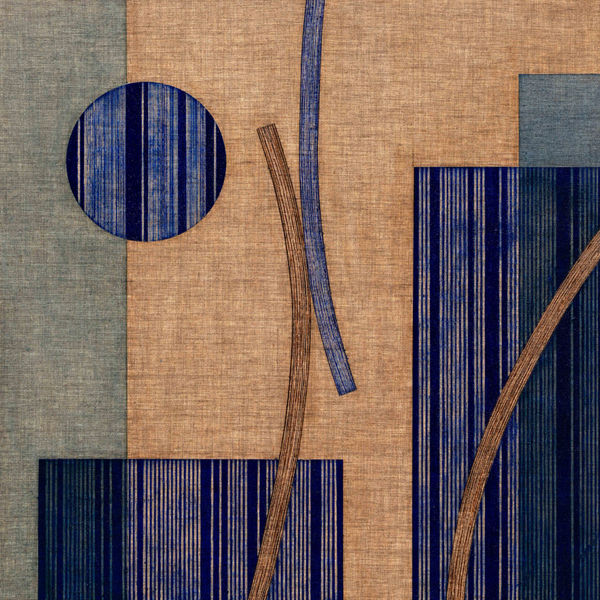
Lee Chae, Maja Klaassens, Paul Beumer and Willem Hussem: A gust of wind gives voice to the trees: In collaboration with DÜRST BRITT & MAYHEW

[ Exhibition extended ] Namuso Gallery is pleased to present A gust of wind gives voice to the trees, a collaborative group exhibition with Dürst Britt & Mayhew Gallery, curated by Jaring Dürst Britt and Alexander Mayhew.
A Gust of Wind Gives Voice to the Trees brings together the practices of Lee Chae, Maja Klaassens, Paul Beumer, and Willem Hussem through a shared sensitivity to nature understood not as image, but as force, process, and condition. The exhibition explores the tension between gesture and stillness, highlighting a shared aesthetic between East Asian minimalist traditions and European abstraction. Across the four practices, simplicity is not an end in itself, but a method through which material essence, duration, and presence are brought into focus. Within this framework, wind functions as an invisible agent, shaping form without appearing as motif.
In the works of Willem Hussem, abstraction is articulated through balance, restraint, and spatial awareness. Sparse gestures and subtle chromatic relations allow movement to be sensed through stillness, giving form to wind as atmosphere rather than depiction. His work establishes a historical foundation for abstraction as concentration and presence.
Lee Chae approaches this condition through process-based painting. In his Tree series, repetition and erasure shape the surface through cycles of removal and renewal. Trees function not as representations, but as structures shaped by pressure, duration, and persistence - registering wind as a transformative force acting upon matter and time.
Maja Klaassens’ Grass series translates natural movement into rhythmic accumulation. Built through disciplined repetition, her paintings register duration and variation without describing landscape, allowing nature to operate as a structuring principle rather than a subject.
Paul Beumer extends painterly thinking into textile and fibre, where folding, layering, and material behaviour embed movement directly into structure. Here, wind is sensed through gravity, surface, and material memory.
Together, the four practices articulate abstraction as a shared pursuit of simplicity and material essence. Wind and tree are not symbols, but conditions through which form comes into being. In this exhibition, they give voice not through depiction, but through tension, rhythm, and quiet persistence.